Pages

Thursday, 25 July 2013

Conference tweeting


At the recent International Symposium on Macrocyclic and Supramolecular Chemistry conference (ISMSC8) there was a distinct lack of interactions through social media.

Whilst coffee breaks and poster sessions were full of interesting chats and discussions, the internet was almost completely ignored by the attendees. The ISMSC website encouraged the use of the hashtag #ISMSC before the conference began. But in the book of abstracts and throughout the conference there was no mention at all of Twitter, I was disappointed.

There were a couple tweets in the build up before the conference, giving hope of a social (media) bunch of people.


But during the conference I found myself a little lonely with only Ivan Aprahamian and Guillaume De Bo really contributing. Ivan summed up the twitter experience calling the crowd "technologically challenged".


With sponsorship from Nature Chemistry and the National Science Foundation, both pretty big in Twitterland, you might have expected some input from them. But alas no, it was left to Chem Comm to join us at the end to publicise the poster prize they were sponsoring.


Another chemistry conference, ISACS11 is taking place this week with around 50 tweets just from yesterday, although mostly dominated by one Chemistry World journalist. Whilst this is not a huge amount it is still much better than at ISMSC8. Derek Lowe is also present and so he's busy blogging through some of the talks.

But what is going on here? Is it just a generation difference and the young folks need to step up or are some conferences missing a trick? Get the discussions going over some coffee sure, but continue it and spread it further on the internet.

Tuesday, 18 June 2013

My first conference talk

The chemistry postgraduate conference was at Leeds last week and I gave my first ever proper conference talk. Being in the last couple months of my PhD and therefore extra busy, extra stressed and with no time for distractions like these silly presentations, I left things to the last minute.

So it was only an internal meeting and the audience mostly made up of other postgrads from the organic section, but speaking to a full room is never an easy task.

The build up

A hash together of group meeting slides and figures from previous reports gave me something to practice in front of the lab group, with 3 days to go. I tend to think I am quite good at winging it and this is generally my theory for life, but in this case it wasn't great. I realised this was kind of a big deal and therefore I should put a bit of effort in. Therefore next couple days were spent creating ChemDraw schemes, making cartoon figures and in 3 hour meetings with my supervisor.

presentation slideAthene Donald wrote a great blog post about the pitfalls of conference presentations, with the key point being practice, practice, practice! I can only agree with her. I also got a handy tip from my supervisor to make sure it started well. he suggested that I learnt a script for the first couple slides of introduction so that I knew exactly what to say at the beginning and wouldn't stumble through incomprehensible mumbles.

Amazingly, it all went rather well. I knew what I wanted to say and said it. I spoke confidently and even managed to get a couple small laughs in, thankfully no tumbleweed moments. I handled some probing questions, avoiding anything too deep on the synthesis or too general on the reasons (applications are overrated). Shown above is one of my slides giving the (one day) infamous cartoon depiction of the cholera toxin protein, everyone knows that it's red right? In our lab, every protein has its own colour.

And relax

My talk was the last one of the day, a potentially awful slot if everyone is fed up by then and itching to get to the wine reception. But it was nice afterwards to not have to sit through any more pretending to listen whilst going over my notes. I had some great feedback from friends and academics and then got in to the bitching about some of the other talks.

Blue background and then blue data points on a graph, bad idea. Switching to a second presentation because you left out or forgot to talk about something, bad idea. Talking in a voice so deep you make the floor vibrate, bad idea (maybe I'm just jealous about not having a deep manly voice for this point).

I now know what to expect next time around and what to do better. I'll always remember this as a first effort and maybe with some feeling of nostalgia. The conference was followed by a ball in the evening that was also a memorable event, or not so for those of us overindulging in the free wine.

Tuesday, 21 May 2013

What am I on about?

Seriously, what on earth am I going on about?

When trying to get your point across, have a debate or tell a story it is very important to say the right words. Communication is all about language and used well can be an incredibly powerful tool.

First some common words

I wanted to have a look at the language I've been using on this blog and see if I'm saying the right things or in fact (more likely) saying some very strange things. I thought that a quick trip over to Wordle, a nice website for making fancy word displays, could tell me what I wanted to know. The 75 most frequently used words from my last 10 blog posts are displayed below.

blog wordle

The most obvious and bizarre thing is that I apparently say first an awful lot! I say first more than any other word. Why? I don't see second in the wordle. Maybe I don't think second is important. Maybe I get so distracted with the first thing that I ramble on and then start talking about other questions like oh look questions is pretty big on the picture too.

Science is up there, journal, work, cover (I do talk about covers a lot) but there are other surprising big ones such as one. When do I say one? Am I talking about unique occurrences or again get bored after the first? I'd like to see more superlatives being used. Great is there, but I have much better words than that in my vocabulary. I think science is wonderful and we should use equally wonderful words to describe the amazing world we live in.

There's no point doing ground breaking work and not telling anyone about it and that's where words come in. Language can not only be useful but also fun. Playing around with your split infinitives can allow you to boldly go where no scientist has gone before.

Saturday, 11 May 2013

Birthday celebrations

This week is my birthday. Woohoo! I'm now into my late 20s, one step closer to death...

Birthday covers

To celebrate my constant loss of brain cells and the failure of my DNA to replicate properly, I thought I'd have a look at another big birthday that happened this year. My favourite journal, Angewandte Chemie, celebrated 125 years of publication.

To celebrate the occasion a gathering of the great and the good was held in Berlin earlier this year. Backs were patted and many nice things were said, including a piece from Stuart Cantrill with some interesting trivia. The journal started as a magazine for industrial chemists published in German, the journal title itself translating as 'applied chemistry'. English readers had to wait until 1962. The journal has actually been going for 126 years but had a year off in 1946 due to the war. So with 125 years of published articles, the covers in January were fittingly congratulatory; fireworks and champagne all round. The Issue: Angew. Chem. Int. Ed. 2013, 52, 1-466  (notably open access).

Angewandte birthday fireworksAngewandte birthday drinks

The original cover

There really is a lot to celebrate for the guys at Angewandte. They've been at the forefront of the evolution of journals over the past 50 years especially. They were the first chemistry journal to introduce graphical abstracts and also the first journal to have pictures on the covers. Before this there was simply a list of featured articles and other journals at the time just started straight off with a table of contents.

The January issue in 1977 was a breakthrough. Scientists now had a platform to paint a picture worth a thousand words. Ok, they weren't as flamboyant as the fireworks quite yet, but a massive leap it must have been.

Angewandte first coverThe paper: Experimental Electron Densities and Chemical Bonding
Found at: Angew. Chem. Int. Ed. Engl. 16, 32-40, 1977

Taking a look at that first cover, all I can say is, wow! What on earth is going on there? To start with, it's in black and white (colour wasn't invented until 1986). A pretty simple picture compared with today's outings but pretty intriguing for a first attempt. There are some contours which suggests an energy landscape with peaks between the, presumably, atoms of C, C and N.

The paper is all about electron densities and quite frankly is way out of my field. But I was right with the contour map, so go me! Taken out of the paper the caption for the image states, "Deformation density in the plane of the three-membered ring of 2,3:5,6-bisepimino-p-benzoquinone at 143 K." Well that certainly clears everything up.

As we've seen, things have moved along significantly. There have also been a few surprises along the way, a humorous cover from 1987 used cartoon acrobats to demonstrate radical chemistry. Perhaps Angewandte should also be congratulated as the original place for TOC ROFL.

Friday, 26 April 2013

Chemical poetry

This week on Twitter has been all about Real Time Chem, if you've somehow missed it then you are spending too much time in the lab.


Real Time Chem is a great community project on Twitter using the hashtag #RealTimeChem. Chemists all over the world have been sharing their daily experiences, lab work, cool articles and finding solace in the fact that they are not the only one failing to purify that unknown black mess.

Amongst other things this week, I have been doing some isothermal titration calorimetry (ITC). A wonderful technique (when it works) of measuring the binding enthalpies and association constants for non-covalent interactions. It's one of my favourite pieces of kit to use; it can give great insight into the success (or failure) of synthesised ligands and makes some pretty graphs.

ITC machine
ITC results


After setting the experiment going I had about 30 minutes to procrastinate before the run was finished. So the internet gets fired up and through a strange connection of aimless link clicking, on websites including "Facebook", "Chemistry World" and "Jet2 cheap flights" (possibly not in that order), I came across Nobel prize winner Roald Hoffmann. Whilst obviously being a great scientist, Professor Hoffmann is also the author of a large number of poems. Some of his work focuses on chemistry and I thought what a fantastic medium poetry is for expressing the wonder and excitement of uncovering nature. I'm sure it would work equally well for portraying the torment and anguish at failed reactions, but let's stick to the wonder for now.

Back at the ITC, a flash of inspiration hit me and I came up with a poem all about the technique...


Isothermal Titration Calorimetry

Separate they contemplate their lives alone
But this the only thought they share
Not knowing their worlds are about to collide
Never loneliness will they again bear

One passively waits for an injection of life
Floating in their own little cell
The other poised to mix at the first chance
That stirring sensation will tell

But it takes another to set their paths
One who knows what makes them attract
To turn up the temperature, wait for the calm
Push the right buttons, see them interact

An initial touch, not sure where it will lead
At first you can never quite know
But a second feel, a larger reach
The heat given off starts to show

As if they had always been as one
They're together and will never part
The creator watches his successful work
Plotting their lives as a chart

Their story lives on for others to see
An example for anyone that looks
To find a guest for that elusive host
Written down in the wisest of books

Saturday, 20 April 2013

Imaginary elements

It's time to sit back and relax. Put your feet up and put on a good film... oh here comes some actual chemistry, a surprising rarity in sci-fi. Oh and it's totally inaccurate, excellent. 

#ChemMovieCarnival

As part of the "chemistry at the movies" blog carnival hosted by @SeeArrOh I'm going to look at a film that split viewers into lovers and haters. Avatar. An epic sci-fi and a basic remake of every other struggle of good vs evil, but with a huge budget and in 3D. So obviously, I thought it was awesome.

The film's premise is based on chemistry. Well at least it is based on the hunt for a new resource, a new mineral, a new element, whatever it is they give it an interesting name; unobtanium. Since Mendeleev put together the world's most famous piece of furniture, chemists have been working to fill in the gaps and add on to the end. So where does unobtanium fit on our nice little table?

Unobtanium?!
Well it doesn't really fit anywhere, it's not real. But being not a real element is not a problem. The fictional element dilithium in Star Trek and the alloy carbonite in Star Wars have both become cult favourites and their use in the films is totally acceptable. The only problem that I have with the fictional unobtanium, is its name. The people at the Resources Development Administration must have used up all the hardtofindium and long ago depleted their stocks of wishwehadmoreofthisium. They had to get their hands on a new super element. James Cameron in his wisdom came up with a totally implausible name that no sane scientist would give to such a sought after material. It's this stupid name that in my opinion lets down an otherwise flawless film...

(What? There are body swapping giant blue aliens and floating mountains? That's totally fine.)

Other appearances

Unobtanium has actually made it to the movies before. In The Core, it was used to build their ship. A scientist in the film gives us a small insight into its composition, he "combined the chemicals in a tungsten titanium matrix", hmm.

The name has also been in use by engineers since the 1950s, according to trusty Wikipedia. So these films really could have put in a bit more effort to come up with something that sounded more sciencey. The tradition now is to name it after the discoverer or institute or a famous scientist, so what was wrong with Pandorium or (an egotistical and possibly worse) Cameronium. Despite being completely silly, unobtanium can still take its rightful place on the periodic table of imaginary elements (I have this poster on my wall), with other beauties such as dalekanium and crapcrapium.

For more Chem Movie Carnival fun follow the hashtag or have a look at this summary. I'd highly recommend the synthesis of kryptonite and how to poison a nitrogen based life form.


claimtoken-51752d618549d

Tuesday, 2 April 2013

The Octacoss!

The Octacoss is upon us! Run for your lives... A recent cover from OBC introduces the latest terror to be unearthed from the depths of the seven scientific seas.

Watch out the Octacoss is about

The Octacoss
This new monster is staring with unblinking eyes, piercing the soul of any unsuspecting readers. But you'd soon forgive him any harm done, as he is rather cute.

The little pink guy is wrapping his far-reaching tentacles around a number of useful objects found lying on the bed of any well stocked laboratory sea. Coral dendrimers; often showing fascinating fractal patterns which may increase the tentacle's reach. Starfish labels; not the usual prey of our 8-legged friends and so instead used undoubtedly as a tool (perhaps a ninja throwing star). Anchor linkers; holding the beast in place and catching any passersby hook, line and sinker.

Boldly displayed on his chest, the creature is showing off a rather geeky tattoo. A chemical schematic of a silsesquioxane with the 8 branches shooting off down his 8 tentacles. The artists have given a wonderfully fun, if not overly dramatic representation of their cubic structure. However, we should now be considering whether a journal cover is the right place to show such ridiculous images. As other academics are likely to be the only people viewing it, will it interest them? There are not many chances for this kind of expression in a field that is often overly serious about itself and so in my opinion, yes, why not have a bit of fun. It's big, it's bold, it's a little bit silly, but it definitely draws you in and it sent me looking up what these silsesquithingys are all about.

Putting the Octa in Octacoss

The Paper: Bioconjugation on cube-octameric silsesquioxanes
Found at: Org. Biomol. Chem., 2013, 11, 2224-2236

The article is a review of recent advances in the modification of these highly symmetric structures. COSS are cube-octameric silsesquioxanes, therefore OCTACOSS are octa cube-octameric silsesquioxanes. The authors seem to have developed an all too common case of RAS syndrome.

It is the biochemical elements in this review that make it stand out (as well as the delightful octopus). COSS are not particularly new structures having first been synthesised in 1955. But the functionalisation and recent biological applications are importantly highlighted.

The high stability and low toxicity of the core structures is discussed in the article. Particular attention is then paid by the authors to the bioconjugation and self-assembly of glycoclusters for studying lectin binding and the use of dendrimer constructs for drug delivery. The review finishes with an analysis of the "most advanced application" of COSS scaffolds as molecular probes. A decent review overall, covering a wide range of uses for a not so monstrous creation.

Sunday, 24 March 2013

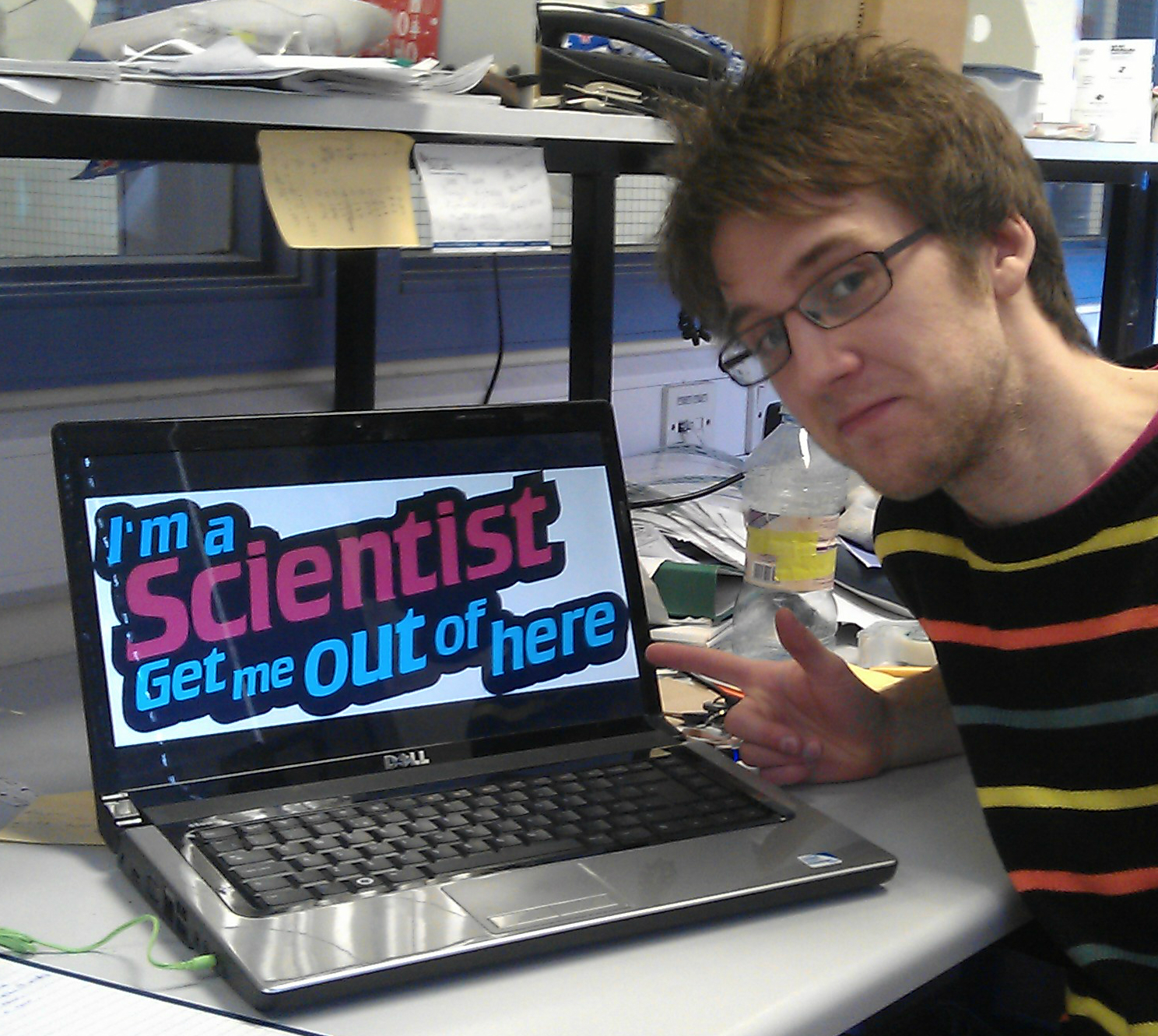
Get me out of here!

What a great couple of weeks it's been and finally I now have a chance to rest. My fingers are aching from typing so much and my brain hurts from puzzling over hundreds of queries. After participating in "I'm a scientist, get me out of here", was it all worthwhile?

The gloves are off

The first week started as a bit of fun, chatting to some kids and quite simply being amazed by the variation of questions that kept popping up on the screen. As the second week began however, things started to get a little more serious.

The fairly sedate pace of the first week saw 3 live chat sessions spread out over the 5 days. By comparison, at the end of the second Tuesday another 4 chat sessions were done. And the end of Tuesday meant it was time for the first eviction. It was Jon that fell at the first hurdle. He admitted that his demise was probably attributed to missing that day's chats due to work. The loss of a fellow scientist made the event suddenly all so real. Could I afford to miss a question so I had time to purify some protein? Could I afford to delay purifying some protein so I had time to answer more questions?

Get me out of hereWednesday saw the loss of Yalda. We had all been in the chats, we had all been quick to get a share of the all important (or not so) first response to questions posted online. So what had made the difference this time? No eye contact in her profile picture was the best suggestion I heard. Did the students want short, straight answers, did they want some humour? Was a question as a reply the best way to engage them, or would a detailed essay be preferred? My guess was a good mix of it all and that's what I went for, although not the easiest thing to pull off.

4 chats were scheduled for Thursday; it was going to be a busy day. The culmination was an exchange with an all girls school, that included arguments over animal testing and inquiries into how many children we all wanted. This may have been the deciding factor of why Claire was next to leave.

So, I was in the final! It was now just me and a fellow PhD student Jack. I was so relieved to have made it through to the end. But after coming so far, my only thoughts were now on the win. Jack obviously felt the same, with some (fairly light) fighting talk on Twitter.

The winner of the Drug Development zone is...

After 2 weeks of grilling the scientists, asking questions that they either never dared or never had the chance to in normal classes and actually getting to know the scientists with some (sometimes too) personal questions, the winners were undoubtedly the students. What a fantastic event it has been, with great credit of course going to the organisers and moderators who kept everything running smoothly. Hopefully I have played some small part in sparking the students' interest in science and maybe even hooking a few in for life.

The results of the all the zones were announced one by one in the "staffroom" on the website, with many of the nervous scientists then expressing their joy and congratulations to their peers. After finishing off the nails on all my fingers, the Drug Development zone was the last to be declared. Jack and I had made that final push for the student votes, there were no more questions to answer and no more opinions to sway. The votes were counted. It was a tie! Equal votes, both winners. A wonderful end to a brilliant event. We congratulated each other and now both have the chance to use the £500 prize for further outreach events. So again, the real winners are the students.

The scheme is running again in June and I would highly recommend it to anyone wanting to get experience explaining theories and concepts to a different audience or just wanting a break from talking to their boring old professor.

Sunday, 17 March 2013

I'm a scientist...

After a week of struggling to answer mind-bending questions and not pass out in manic live chats, I've come to the conclusion that 13 year-olds are actually a fairly intelligent and extremely inquisitive bunch.

Like X factor for scientists

I'm a scientistI was picked to be part of the national on-line event "I'm a scientist, get me out of here"! It's an excellent initiative run 3 times a year, where school kids can literally ask a scientist anything they want.

The event has been running for a few years and this March they have 11 zones each with 25 school classes, which means a lot of kids to contend with. The places for scientists were 6 times oversubscribed and this time they have added more zones in an attempt to accommodate more schools. It's popular, but why?

I've been involved in outreach programs before. I've helped out at Uni open days and demonstrated experiments for school kids coming in. A year ago I took part in (the now defunct) Researchers in Residence, where I went into a year 11 class for a number of weeks. During this time I talked to them about my work, arranged for a trip for them into university and naturally tried to encourage them all to become scientists. These schemes were great at showing children a human side to science and allowing them to see what a university and an actual "scientist" are really like. This is where I'm a scientist excels.

The kids get to post questions on the website and then bombard us with yet more in the live chats. Most so far are real science queries with most of them based on drugs (me being in the Drug Development zone). The real novelty of this project however, is that in the following week I may be kicked out. Every day the children will vote for their favourite scientist out of our group of 5; who answered their questions best, who sounded most intelligent or simply who told the best joke. At the end of each day one will leave and by Friday only one will remain victorious held aloft by their teenybopper fans.

Hello why do you like science

So the kids can connect with scientists and ask all the questions they never get to in their normal science lessons. But as I said, not all of the questions are sciencey. The others include gems such as, "waffles or pancakes?" and "how tall are you?". But these questions are equally important as they allow the scientists to become real, human people. We are not a bunch of deranged lab rats nor are we an elitist, higher intelligence (even if I'd like to think so sometimes). Connecting with the school children through these silly questions lets them see us for what we really are; just like them. With this in mind, hopefully they will realise that science is for them and in a few years they'll be the ones changing the world and inspiring the next generation.

As for me, I'm thoroughly enjoying the experience. I've answered all the questions I could and even answered some that I had no idea about before. My enthusiasm for science and engagement has rocketed and my lab work has suffered immensely. But with my supervisor away this next week I may get a little obsessed answering questions and reading ones from the different zones, that is unless I get evicted...

Friday, 1 March 2013

Posting a winning formula

Last week the Masters students in Leeds presented posters on their work as part of their degree course. For the few weeks beforehand (yes it took them a few weeks) they were mostly hidden away behind a computer changing fonts, images, headings and references until they had something resembling a five-year-old's first attempts at potato printing.

Winning is not so blue and white

After a little bit of tweaking, arguments over font size and drastically changing the colour scheme, the butterfly finally emerged from its chrysalis. But no, they were not actually all that bad, especially for a first attempt. Few people realise how difficult it is to make something scientifically accurate and also visually stimulating.

As an example, below are 2 posters that came out of my lab from PhD students. So which do you think won a prize when presented at a conference?

Better poster?
Best poster?


To put you out of your misery, the answer is both. Both designs won best poster awards at different meetings. But they are obviously quite different. Nature Journal believes a good poster could "change your career", so what is the secret formula for success?

Well in my opinion the poster on the left looks a lot better. It has more colour, lots of different images, not much writing and easy to follow sections for different parts of the presentation. But I would say all this, as I created it. By contrast, the poster on the right has a lot of small writing, it's very white and appears overly crowded. But they both were winners.

They both do have many images and diagrams, they both have a fair amount of data presented and they are both blue, not so different as it might first seem. A poster has to be eye-catching in some way or at least grab your attention for long enough so that you read a few lines and get hooked. From then on in it has to be ordered, easily understood, not overloaded with information and with a few pretty pictures thrown in for good measure.

The designer of the right poster is also one of the best talkers that I know. She can talk about anything and make it sound interesting (even her research). And this is a great skill that you can't show on a piece of paper. Being able to verbally communicate with your audience, to not confuse them or bore them, is vital. Knowing your audience and being able to change the language you use and the way you describe things can really make the difference. This might be between someone just saying hi to be polite as they quickly walk past, or being drawn in by a few well chosen words.

Teacher knows best

So back to the masters students. It took me a lot of effort to convince one student that brown and pink perhaps didn't make the most pleasing of background colours. The text was cut down by half; no one wants to stand there for an hour reading. We removed the empty white space by increasing image sizes and rearranging text boxes. And I even got my name squeezed into the acknowledgements. But I did fail to make him increase the font size, even after much pleading and threatening to sabotage his work. It was perfectly readable on the computer screen, but when printed and up on a large stand he admitted that you probably get a better view if you don't have to stand with your face 10 cm from the board.

Being bold and confident in your abilities is great. And in the end you have to be comfortable with what you've produced otherwise you won't be able to talk about it effectively. But one thing I've learned over the last few years, is that I don't always know best (many will be amazed to hear me say this). Take advantage of any help you can get. Use other people's knowledge. Seek a different opinion. Do this and you will better yourself. I never thought poster design could be so philosophical.